Reverse flashcards: a key to language production
As I was studying Greek I’d have a frustrating experience that I think a lot of language-learners can relate to. A word I’d seen dozens of times, and could easily recognize on sight, would seem to disappear from my brain when trying to recall it while speaking.
Language teachers and researchers calls this difference between comprehension and production. I had no problem understanding a word I read or heard, but that ability didn’t translate to my ability to spontaneously produce the word while speaking.
Conversation practice is one way to work on this, but often my conversation practice sessions would just remind me what I didn’t know. How do you actually practice producing something you can’t remember in the moment?
Part of the answer for me when I was using paper flashcards was simple: run the flashcards the other way, showing the answers first. I might not be able to recall the Greek word for “novelist”, but I know the English word; if I’m running my flashcards English-side first, it gives me a chance to work on producing, rather than recognizing, the word I’m after, until I can finally recall the word μυθιστοριογράφος (mythistoriographos) in conversation.
Since comprehension and production can be thought of of as different skills, it can be helpful to see where you’re at. I might get eight out of ten flashcards in a deck going through the normal, comprehension-focused way, but only get half that many going through in reverse. I’m the kind of learner who wants to know where I’m at, so I know what to work on. A study tool or system that lumps together comprehension and production into one bucket doesn’t help you do that.
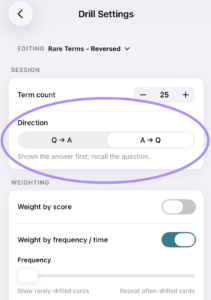
That’s why Lexolotl tracks both directions, independently. Every term you drill keeps two separate scores: a forward score (recognizing the answer from the question) and a reverse score (recalling the question from the answer), each on a 0–5 scale. When you run a drill your drill settings control the direction, question→answer or answer→question, and the rating you give updates only that direction’s score. Knowing μυθιστοριογράφος when you read it and knowing it when you have to produce it are two separate facts about your memory, and Lexolotl keeps them separate.
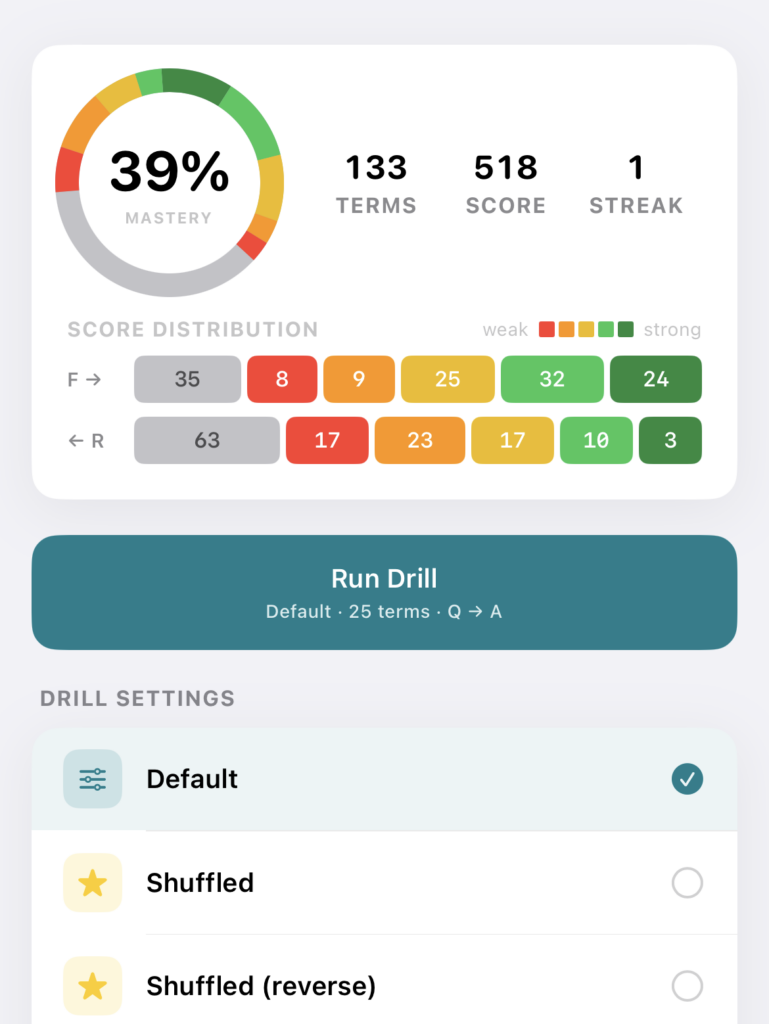
This info is instantly visible in the mastery ring on each deck’s home screen: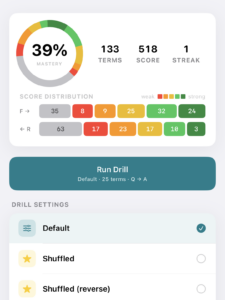
It shows both directions at once: the right half fills with forward mastery, the left half with reverse, meeting at the bottom. Within each half, the arc is broken into segments sized by how many terms sit at each mastery level — so a weaker direction reads as a wider unmet gap. The same info is given in the two separate Score Distribution bars below the ring. You don’t have to interrogate a spreadsheet or exam scores. You glance at the ring and the asymmetry tells you: my reading’s ahead, my production’s lagging, that’s where the work is. For me that meant a left half that was visibly thinner than the right for months — an honest picture of exactly the gap I’d been hiding from. And as I worked on that reverse direction, it wasn’t just about improving a score; my productive conversation ability started to improve, as I was able to recall more words instantly to say what I wanted.
And once you can see the gap, you can drill it. Flip a deck to answer→question and you’re forced to produce instead of recognize. Pair that with score weighting — the six draggable bars that lean a session toward whichever mastery levels you raise, or the time settings that let you focus on cards you are not seeing very often — and you can spend a whole session doing nothing but hauling your weakest reverse-direction terms up out of the “shaky” pile.
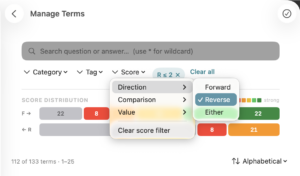
If you’ve been growing your deck for awhile and have hundreds of terms and really want to dig into the details, Lexolotl gives you some power-user features: go into Edit Deck→Manage Terms, and there you can query for terms that have a particular reverse-score range, compare the forward score for each, and even go through and apply tags to them for a custom drill.
That’s the idea behind the whole app, really: a flashcard should tell you the truth about what you know, including the uncomfortable half. Reading Greek fluently while stumbling to speak it isn’t a failure — it’s just the normal shape of a half-learned language. The point is to see that shape clearly enough to fix it.
If you’ve ever known a word perfectly on the page and lost it completely out loud, that gap has a home in Lexolotl now.
Lexolotl is a spaced-repetition flashcard app for iPhone, iPad, Mac, Apple Watch, and Vision Pro. Download on the App Store.